Ask me any question, I'd love to hear what brought you here!
Ask a query
Explore more on Odisha Tourism...
Welcome Back!
Sign in or create your free account to unlock unlimited access.
Iconic Odisha
Shree Jagannath Temple, Puri
One of India’s most revered pilgrimage sites Shree Mandir better known as the Jagannath Temple to the outside world in Puri is the epicentre of Odisha’s spiritual and cultural life. Built in the 12th century by King Anantavarman Chodaganga Deba the temple is dedicated to Lord Jagannath, worshipped alongside his siblings Lord Balabhadra and Debi Subhadra.
Its towering temple dominates the sacred skyline of Puri and has drawn devotees from across the world for centuries. The temple is especially famous for the grand Ratha Jatra or Chariot Festival as it is known worldwide. Massive wooden chariots carry the deities through the streets in a spectacle witnessed by millions.
The temple kitchen considered among the largest in the world prepares Mahaprasad using traditional cooking methods passed down through generations.
Why is it Iconic
- One of the Char Dham pilgrimage sites in India
- World famous Ratha Jatra festival
- Unique Jagannath culture and rituals
- Home to the largest temple kitchen serving Mahaprasad
Sun Temple, Konark
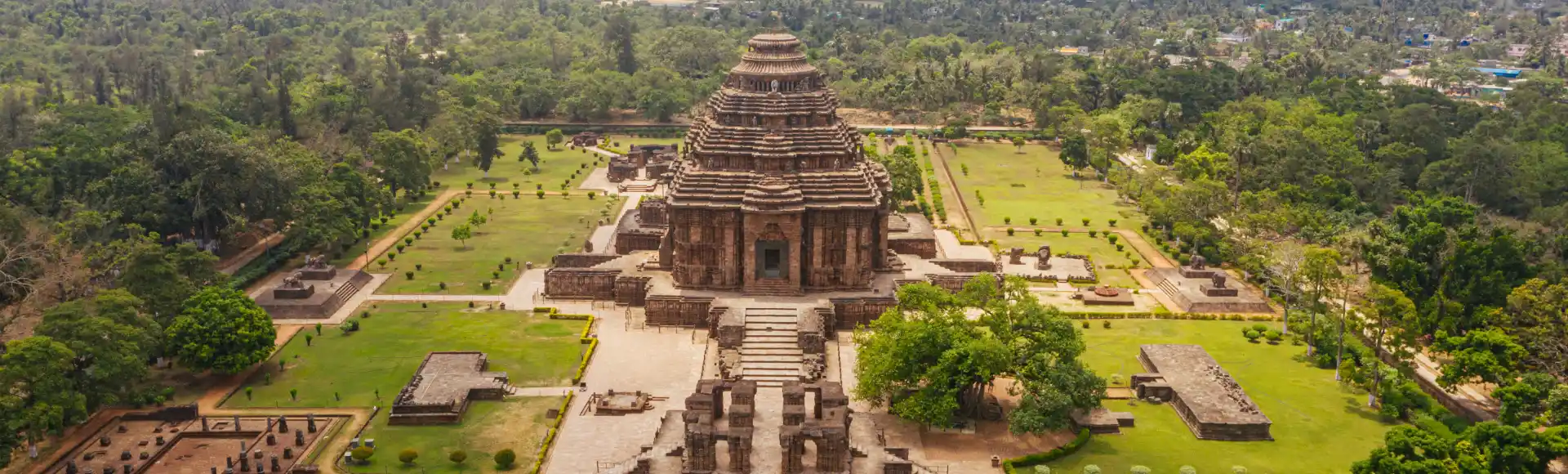
The Sun Temple at Konark is one of India’s most extraordinary architectural masterpieces. Built in the 13th century by King Narasimhadeva I of the Eastern Ganga dynasty the temple was designed as a colossal chariot dedicated to Surya, the Sun God.
The monument features intricately carved stone wheels, pillars and sculptures that showcase the brilliance of medieval craftsmanship. Each wheel of the chariot represents the passage of time and functions as a sundial.
Recognised as a UNESCO World Heritage Site, the temple remains a powerful symbol of Odisha’s artistic and architectural excellence.
Why is it Iconic
- UNESCO World Heritage Site
- Temple shaped like the Sun God’s celestial chariot
- The famous stone wheels that function as sundials
- It represents the pinnacle of Kalingan temple architecture
- The temple is a masterpiece of artistic and scientific confluence
Ekamra Kshetra, Bhubaneswar
In the heart of Bhubaneswar lies Ekamra Kshetra or Old Town as it is commonly called a timeless sacred landscape where the rhythm of life feels strikingly different from the city’s fast paced modern avenues.
Around the serene waters of Bindu Sagar Lake priests chant morning prayers families quietly perform rituals for their ancestors and residents go about their daily chores amid centuries old temples that shape the skyline.
At the centre rises the towering Lingaraj Temple watching over a neighbourhood where time seems to slow down. While the rest of Bhubaneswar moves with the energy of a growing modern city, Old Town continues at its own gentle pace here heritage is not preserved behind walls but lived every single day.
Why is it Iconic
- Living Temple City: Unlike archaeological ruins Ekamra Kshetra is a living functional heritage site where centuries old traditions continue alongside modern life.
- Epicentre of Kalinga Architecture: It showcases the complete evolution of the Kalinga style with the 11th century, 128-foot high Lingaraj Temple being the most prominent alongside Mukteswar, Rajarani and Ananta Basudeb temples.
- Historical & Spiritual Continuity: It spans over 2,000 years of history (3rd Century BC to 15th Century AD), including sites related to Buddhism (Ashokan Rock Edicts at Dhauli), Jainism (Udaygiri-Khandagiri) and Hinduism.
Chilika Lake
Chilika is more than a lake it is a living landscape where river meets sea and freshwater blends with saltwater. Spread across the districts of Puri, Khordha and Ganjam it is Asia’s largest brackish water lagoon.
Fed by dozens of rivers and linked to the Bay of Bengal, Chilika constantly shifts with the seasons, shaping islands, wetlands and rich biodiversity.
Recognised as a Ramsar Wetland of International Importance it is one of Odisha’s greatest natural wonders.
Why Chilika is Iconic
- Asia’s Largest Brackish Water Lagoon - Where freshwater rivers merge with the tidal waters of the Bay of Bengal creating a unique and highly productive ecosystem.
- A Global Birding Destination - Every winter more than a million migratory birds arrive from regions as distant as Siberia, Central Asia and the Himalayas.
- Home of the Irrawaddy Dolphin - Chilika supports one of the largest lagoon populations of the endangered Irrawaddy dolphin in the world.
- A Living Cultural Landscape - Sacred temples, fishing traditions and festivals are deeply intertwined with the rhythm of the lagoon.
- A Conservation Success Story – Community led restoration efforts helped revive the lake’s ecology making Chilika an internationally recognised example of wetland conservation.
Similipal National Park
Located in Mayurbhanj district, Similipal is one of India’s most remarkable forest landscapes and a cornerstone of Odisha’s wilderness. It was among the first nine reserves brought under Project Tiger in 1973 and today forms part of the Similipal Tiger Reserve and Biosphere Reserve protecting rich biodiversity within the Eastern Ghats. Dense sal forests, rolling hills and wild orchids the red simul cotton trees after which it gets its name and winding rivers define this vast wilderness. Similipal is also the only place in the world where the rare Melanistic (black) Tiger has been recorded in the wild. Alongside Royal Bengal tigers, the forests support elephants, gaurs, leopards, mugger crocodiles and a remarkable variety of birds and reptiles. The reserve is equally famous for its dramatic waterfalls Barehipani, India’s second highest waterfall and the majestic Joranda Falls cascading through deep forested valleys. For travellers seeking raw nature and wildlife, Similipal reveals Odisha at its wildest.
Why is it Iconic
- Among the first nine Tiger Reserves under Project Tiger (1973)
- Only known habitat of the rare Melanistic (black) Tiger
- Home to spectacular waterfalls like Barehipani and Joranda
- One of India’s richest biodiversity landscapes in the Eastern Ghats
- Home to numerous indigenous communities, such as the Mankidia and Santals, who live in harmony with nature and maintain ancient, sustainable lifestyles
Hirakud Dam & Reservoir
Stretching across the mighty Mahanadi River near Sambalpur the Hirakud Dam is the longest earthen dam in the world. Completed in the 1950s it was built to control floods and support irrigation and power generation across the region. The dam created the massive Hirakud Reservoir an artificial lake a sprawling water body dotted with numerous islands and scenic viewpoints. Over time the reservoir has also become an important wetland ecosystem attracting migratory birds. Today Hirakud stands not only as a remarkable engineering achievement but also as a destination where nature, water and landscapes come together.
Why is it Iconic
- It was one of the first major post-independence multipurpose river valley projects marking a massive step in India's engineering capability
- The reservoir formed by the dam is one of Asia's largest artificial lakes covering a vast area of 743 sq. km at full capacity with a massive 640 km shoreline.
- The dam transformed the region by controlling floods in the Mahanadi delta providing irrigation for over 75,000 sq. km and generating over 300 MW of hydroelectric power.
- It is one of the most important wetland ecosystems in Odisha attracting lakhs of migratory birds every winter and the delta is home to one of Odisha’s most scenic wildlife sanctuaries - the Debrigarh Wildlife Sanctuary
Buddhist Diamond Triangle
The Buddhist Diamond Triangle refers to the archaeological sites of Ratnagiri, Udayagiri and Lalitgiri located in Odisha’s Jajpur district. Having flourished between the 2nd Century BCE and 12th Century CE these monastic complexes were important centres of Buddhist learning and spirituality. Excavations have revealed monasteries, stupas, sculptures and inscriptions that highlight the region’s role in the development of Mahayana and Vajrayana Buddhism. The hilltop ruins and large brick stupas offer a fascinating glimpse into Odisha’s ancient connections with the Buddhist world.
Why is it Iconic
- Major Buddhist archaeological cluster in eastern India.
- The region was a major hub for Vajrayana (or "Diamond Vehicle") Buddhism, a form of tantric Buddhism that flourished under the Bhaumakara dynasty (8th-10th century CE).
- Ancient Pushpagiri Mahavihara (University) a prestigious center of Buddhist knowledge that flourished between the 7th and 12th centuries CE
- The sites are on the UNESCO World Heritage Tentative List highlighting their global cultural significance.
- The sites offer a rare continuous timeline showing the evolution of Buddhism from Hinayana (early period 2nd Century BCE at Lalitgiri) to Mahayana and finally to Vajrayana until 12th Century CE.
- Reflects Odisha’s ancient global cultural links.
Highlands of Odisha
Mist drifts across emerald hills, pine forests whispers in the wind and waterfalls echoing through deep valleys.
Welcome to the Highlands of Odisha a landscape where the Eastern Ghats reveal their most breathtaking secrets. From the towering Deomali Peak to the tranquil valleys of Putsil and the cool forests of Daringbadi this region is Odisha’s ultimate mountain escape.
For travellers seeking nature, culture, adventure and serenity the highlands offer an unforgettable journey into the heart of Eastern India.
Why is it Iconic
- Touch the Roof of Odisha - Trek to Deomali, Odisha’s highest peak where sunrise views unfold above rolling clouds and endless Eastern Ghats.
- Nature in Its Wildest Beauty - From the thunderous Duduma Waterfall to the sweeping green vistas of Putsil Valley the highlands are a playground for nature lovers.
- Where Cultures Meet the Mountains - Discover vibrant tribal traditions, Kotpad handloom craftsmanship and the serene Tibetan settlement of Jirang.
- Odisha’s Coolest Hill Escape - Breathe the pine-scented air of Daringbadi fondly known as the Kashmir of Odisha where mist covered forests and scenic waterfalls create the perfect mountain retreat.
Handlooms of Odisha
Odisha’s handloom traditions represent centuries of craftsmanship and cultural identity. Among the most celebrated are the vibrant Sambalpuri Ikat textiles of western Odisha and the elegant Brahmapur Pata Silk Sarees from Southern Odisha. Sambalpuri Ikat uses the intricate ‘Bandha’ technique where threads are tie-dyed before weaving to create complex patterns and motifs. Brahmapur Pata Sarees are known for their rich silk texture and distinctive borders, often worn during festivals and temple rituals. These textiles are created by skilled weaving communities whose artistry continues to keep these traditions alive.
Why is it Iconic
- The Sambalpuri Handloom sarees are GI tagged and represent Odisha's rich heritage, often worn for their artistic value and high-quality handmade nature.
- Originating in the 14th century the Brahmapuri Pata is a 200-year-old traditional craft is deeply rooted in the history of Odisha's Silk City - Brahmapur.
- Unlike printed fabrics, the warp and weft threads are tie-dyed before weaving. This meticulous process creates intricate patterns with a signature blurred edge of the Sambalpuri Handloom.
- Traditionally, Brahmapuri Patta is woven as a pair - a Saree for the woman and a matching pair of dhotis and stole for the man. This signifies unity and is essential for religious ceremonies and weddings.
- The traditional colour palette of red, black and white found in Sambalpuri Handloom represents the face of Lord Jagannath.
- The Brahmapur Pata Sarees are considered so auspicious that they are used to adorn the deities at the Jagannath Temple in Puri.
Silver Filigree of Kataka
Silver Filigree, locally known as Tarakasi, is one of Odisha’s most refined craft traditions and has been practiced in Kataka for centuries. The craft involves twisting extremely fine strands of silver wire into intricate lace-like designs. These delicate patterns are then soldered together to create jewellery, decorative artefacts and ceremonial objects. The craftsmanship requires immense precision, patience and skill. Even today, traditional workshops in Kataka continue to produce exquisite filigree creations admired across India.
Why it’s Iconic
- Tarakasi derived from tara (wire) and kasi (design) is a delicate craft in which fine strands of silver are twisted, curled and soldered to create intricate patterns. Perfected over more than 500 years, this exquisite silver filigree tradition remains uniquely associated with the city of Kataka.
- Tarakasi is inseparable from Odia culture, particularly in wedding rituals and festivals. The most famous example is the Chandi Medha (silver backdrop) used for Goddess Durga during Durga Puja in Kataka.
- The craft has been granted a Geographical Indication (GI) tag recognising its exclusive origin and traditional techniques. While it shares similarities with delicate filigree traditions of ancient Greece, Rome and Egypt, Tarakasi has evolved a distinctive character.
Odissi Dance
Odissi is one of India’s oldest and most graceful classical dance traditions, embodying the artistic soul of Odisha. Rooted in the temples of the region, it evolved through the devotional performances of Mahari and Gotipua dancers who offered dance as an expression of worship. Marked by fluid movements, expressive hand gestures and the iconic Tribhangi posture, Odissi mirrors the sculptural elegance seen on the walls of Odisha’s ancient temples. Each performance blends rhythm, poetry and storytelling, often drawing from mythology and the divine love of Lord Krishna. Today, Odissi has travelled far beyond its temple origins, captivating audiences across the world while continuing to preserve the timeless grace and spiritual essence of Odisha’s performing arts.
Why is it Iconic
- Dating back to the 2nd century BCE, Odissi is one of the oldest classical dance forms in India and is deeply rooted in the Natyashastra.
- The performance is highly structured, featuring a blend of Nritta (pure technical dance) and Nritya (expressive dance), culminating in Moksha - a final spiritually charged dance symbolizing liberation
- Such is the global appeal of Odissi that the King of Pop - the late Michael Jackson incorporated Odissi Dance in his 1991 chartbuster ‘Black or White’ - a song whose message of unity continues to resonate worldwide.